Almuíña
Parroquia of Gondulfe (San Lourenzo)
Concello of Taboada
The only one of the five that goes without the article. And the concello with the highest density of the surname in all of Galicia: 11.31 per thousand.
Galician surname · documented since 1505
From the Arabic múnya, “the desired thing”,
to the enclosed orchard of a village in Lugo.
This is not a page that sells you a parchment. It is what can be proved about the surname Almuiña, with the source beside every figure, and what cannot be proved, said as well.
Chapter I · The word
Almost every surname has lost its meaning along the way. Almuiña has not: it is still a living word in Galician, and it is in the Academy's dictionary. Anyone surnamed Almuiña is, quite literally, surnamed “orchard”.
almuíña, s. f.: Horta, xeralmente pequena e cerrada, na que adoita haber árbores froiteiras.
In English: “an orchard, generally small and enclosed, in which there are usually fruit trees”. The Academy itself uses it in an example that smells of summer: “Plantou uns pexegueiros na almuíña” — he planted some peach trees in the almuíña.
It is not just any vegetable plot. It is the enclosed one, the one beside the house, the one with a wall or a hedge and fruit trees inside. In the Galicia of the minifundio — land split into tiny holdings — that plot was the family larder and very often the only thing genuinely one's own in a world of land held under foro, the long Galician leasehold.
The surname is not born in Galicia. It is born in Arabic.
It was not a subsistence plot. In al-Andalus the almunia was a peri-urban estate that did two things at once: it produced — fruit trees, vines, vegetables, with its irrigation system and its water tank — and it served as a retreat for the aristocracy and for the royal family itself, who left the city to rest, hunt and write verse while keeping an eye on the harvest.
Hence the double meaning of the Arabic word. Munya is “the desired thing” and also “the orchard”: the place one wants to go to. It is hard to find a surname with a more agreeable etymology to carry.
Here one has to be honest, because this is the awkward question. The Andalusi presence in Galicia was extremely brief — barely a few decades in the eighth century — and Galician place names contain few Arabisms. The most widespread by far is aldea, “village” (from Andalusi aḍ-ḍáyʿa), with more than a hundred entries; then come atalaia, albariza and little else. Almuíña is one of those few.
What can be stated with certainty is where the word comes from: the Toponomasticon Hispaniae, a university place-name project, devotes an entry to the etymon MÚNYA and records Galician almuíña alongside Portuguese almuinha, Castilian and Aragonese almunia and Catalan almúnia, all with the sense of “farmstead”.
What cannot be stated is that an Andalusi planted the first almuiña in Taboada. The plausible account is an agricultural loanword: the word travels from south to north with the thing it names — a particular way of enclosing and planting an orchard — by way of agricultural Latin, of the neighbouring Romance and of monastic documents. The technique travelled, and the name with it.
A kinship with muíño (“mill”) has been suggested once or twice on grounds of phonetic similarity. It does not hold: the sense endorsed by the Real Academia Galega and by historical lexicography is that of “orchard”, and the chain from munya is documented right across the Peninsula.
From the same Arabic etymon came six surnames, one per Peninsular language. Set the Spanish census figures beside them and something nobody mentions appears: the Galician form is the most numerous of them all.
| Surname | Language or territory | INE rank | First surname | Second surname |
|---|---|---|---|---|
| ALMUIÑA | Galician | 12,687 | 282 | 268 |
| ALMUNIA | Castilian and Aragonese | 13,604 | 257 | 348 |
| ARMUÑA | Castilian (Guadalajara) | 36,636 | 66 | 91 |
| ARMUNIA | Castilian (León) | 69,955 | 26 | 24 |
| ALMOINA | Catalan and Valencian | 74,389 | 24 | 13 |
| ALMOYNA | Catalan, old spelling | 76,928 | 23 | 9 |
INE, surname frequencies, census of 1 January 2025. The correspondence between forms and languages is that of the MÚNYA etymon entry in the Toponomasticon Hispaniae.
Almuiña beats Almunia by 25 bearers. Of all the Romance offspring of munya, the one that has held up best is the one that went off to live in the rainiest, most far-flung corner of al-Andalus.
Chapter II · The land
Almost every page that discusses this surname repeats that there are four places called Almuiña. We downloaded the whole Nomenclátor de Galicia 2026 — 38,762 official place names — and searched it ourselves. There are five.
Parroquia of Gondulfe (San Lourenzo)
Concello of Taboada
The only one of the five that goes without the article. And the concello with the highest density of the surname in all of Galicia: 11.31 per thousand.
Parroquia of Santo Acisclo do Valadouro (Santo Acisclo)
Concello of Foz
New entry: it was not in the 2003 Nomenclátor and it is in the 2026 one. In A Mariña, a step away from Galdo, where two Almuiña go to law in 1722 and 1776.
Parroquia of Arbo (Santa María)
Concello of Arbo
On the banks of the Miño, in O Condado, land of vines and lamprey. 8 bearers today, 2.99 per thousand.
Parroquia of Valeixe (Santa Cristina)
Concello of A Cañiza
In the heart of A Paradanta. 8 bearers, 1.57 per thousand.
Parroquia of Salcedo (San Martiño)
Concello of Pontevedra
In the countryside of the concello of Pontevedra itself, nowadays almost city.
Accent-insensitive search across the nine columns of the Nomenclátor de Galicia 2026 (Xunta de Galicia, approved on 30 March 2026), downloaded from the open data portal. Five exact matches, not one more.
Four of the five are A Almuíña, with the article, the way you name a place that is still remembered as having been a thing: the orchard. The one at Gondulfe, in Taboada, is plain Almuíña. It has lost the article, which is what happens to a common noun that has spent long enough being a proper name. And Taboada happens to be, by a long way, the concello (municipality) where the surname weighs most in all of Galicia.
In the file, the columns for the 2003 Nomenclátor are empty for A Almuíña in Santo Acisclo do Valadouro: the place appears only in the 2026 revision. That is, there is a place called Almuíña that has entered the official place-name register of Galicia this very year. The oldest surname in the world with a brand-new toponym.
Cross the place names with the distribution of the surname and with the archive documents, and the map stops being a smudge and turns into four specific comarcas (districts):
Almost every heraldry website takes it for granted that the lineage comes from a Torre da Almuíña in Santa Cristina de Valeixe (A Cañiza). We went and checked. That tower is not in the Patrimonio Galego catalogue, which for that parroquia lists four properties and not one of them is a tower; it is not in the list of pazos (Galician manor houses) drawn up by the Concello da Cañiza itself; and it is not in the local historiography of the Condado de Salvaterra.
The chain of citations always ends up in the same place: the García Carraffa and the Baron of Cobos de Belchite, from there to the commercial websites, and from there everywhere. And those same sources contradict one another: another version puts the ancestral seat in Crecente and takes it to have been laid in ruins by the Sotomayor. The same goes for a supposed pazo of the lineage in Landrove: it appears in no catalogue at all.
And there is one case where it pays to be blunt. The Casa Grande de Almuíña de Arbo is not the pazo of the Almuiña. It is a house in the place called A Almuíña, and every one of its documented owners bears a different surname: Estévez de Puga y Méndez from 1665, then Vieytez, Rivera and Giráldez. The shields it preserves read as the arms of Durán, Puga, Correa, Feixoo and Ribeiro. Not one of them is Almuiña's. That a house should stand in A Almuíña says nothing about who held it, because almuíña is a common noun: it means orchard.
Curiously, the one concentration that does hold up is the one nobody was citing. Landrove, in Viveiro, is documented three times in three different archives: two students at Alcalá (1792 and 1803), the 1829 embarkation licence for Cuba and a lawsuit of 1832. There is no tower, but there is a family.
313 concellos with their actual geometry. In gold, the five that have a place called Almuiña; the intensity of the colour measures how many Almuiña there are per thousand inhabitants according to the Instituto Galego de Estatística.
Loading the map…
Tap a concello to see its figure
Geometry: official municipal boundaries (georef-spain-municipio). Surname data: IGE, municipal distribution as at 1 January 2023, only concellos with more than 5 bearers.
Chapter III · The trail
The Arquivo do Reino de Galicia holds a good twenty-odd lawsuits with an Almuiña inside them, from 1505 to 1786: foros, payments of maravedís, inheritances, a parish priest, a licenciado, two women acting in their own right. They are not great deeds. They are exactly what people did: argue over what was theirs in front of a notary. And that is how we know they were there.
For a long time 1603 was given as the first trace of the surname. That is half true, and the missing half changes the century the story starts in. Search the archive catalogue with the modern spelling, Almuíña, and before 1603 absolutely nothing comes up. Zero records. But the surname is indeed there earlier: it is written Almoiña, Almoíña, Almoina.
Redo the search with the old spellings and the trail goes back to 1505, and documents turn up that were on no list at all: the foro granted by A Franqueira to María de Almoiña, a lawsuit between three Almoíña in 1558, Juan da Almoina's vineyard in 1577, the cleric of 1587, the resident of Banga in 1596.
And there is one that ties the whole thing together. In 1630, Pedro de Almoíña goes to law “sobre posesión de una heredad en el lugar de Almuíña, en la jurisdicción de Taboada” (over possession of an estate in the place of Almuíña, in the jurisdiction of Taboada). The link between the old spelling and the place name is not made by this page: it is made by the archive's own catalogue, which indexes that lawsuit under the geographical descriptor Almuiña (lugar, San Lourenzo de Gondulfe, Taboada, Lugo).
A lesson in method, and it holds for any surname: if you search for your surname the way it is spelled today, you find half of it. Before spelling settled down, every notary wrote what he heard.
On 1 May, the monastery of Santa María da Franqueira grants under foro to María de Almoiña and her husband — the parchment has faded at exactly that point and the catalogue reads it with a query, “Estevo? de Parga?” — the casal da Rotea, in Santa María de Casteláns and Santa Mariña de Covelo, for two fanegas of grain a year. Note the detail: the one who bears the surname is she.
Arquivo do Reino de Galicia · PLAN-4805Domingo de Almoíña, a resident of the land of San Martiño, against Pedro de Almoíña, over the property left by Álvaro Lorenzo de Almoíña. Three bearers of the surname in a single lawsuit, half a century before the first “Almuíña”.
Arquivo do Reino de Galicia · Caixa 20600-19Juan da Almoina against Melchor Fernández, over the fruit of a vineyard. One of the two documents that turned up on searching by the old spelling and that were on no previous list.
Arquivo do Reino de Galicia · Caixa 1147-68Vicente de Almoíña, cleric, against the apostolic judge Domingo Ramos, seeking protection of his possession of the benefice of San Cosme de Gondel. Ecclesiastical force: the cleric asks the Audiencia (the royal high court) to rein in the Church's own judge.
Arquivo do Reino de Galicia · Caixa 26813-5Sebastián de Almoina, a resident of Santa Baia de Banga. The other find from the search by the old spelling — and in Banga, exactly where genealogy placed the documented birth of 1720.
Arquivo do Reino de Galicia · Caixa 45520-3Alonso de Almuíña with María de Prado, a widow, over a payment of maravedís. For years it was taken to be the oldest document of the surname. What it really is is the oldest one with the modern spelling: in the archive, before this date, there is not one single “Almuíña”.
Arquivo do Reino de Galicia · Caixa 26115-69Pedro de Almoíña, guardian of the children of Alonso de Almoíña, against Inés de Fontao, “sobre posesión de una heredad en el lugar de Almuíña, en la jurisdicción de Taboada” (over possession of an estate in the place of Almuíña, in the jurisdiction of Taboada). It is not us saying so: the archive indexes it under the descriptor Almuiña (lugar, San Lourenzo de Gondulfe, Taboada, Lugo). Surname and place name, tied together by the catalogue.
Arquivo do Reino de Galicia · Caixa 21708-7Domingo de Almoíña and his brothers against Juan González Herrero, over property in the jurisdiction of Vigo.
Arquivo do Reino de Galicia · Caixa 24393-130Juan Andrés and Juan de Almuíña litigate over the property of María Fornelos, wife of Lorenzo de Castro.
Arquivo do Reino de GaliciaPedro Almuíña and associates, with Felipe Rivera, in an execution over maravedís.
Arquivo do Reino de GaliciaAntonio Almuíña, licenciado, before the court of Porriño over the execution of the will of Domingo de Abeledo. The first Almuiña with a university education to appear in writing.
Arquivo do Reino de GaliciaAntonio Almuiña Rivero, cura (parish priest), litigates against the Provisor of Santiago, claiming the ecclesiastical fuero, the clergy's own jurisdiction.
Arquivo do Reino de GaliciaAndrés de Almuíña with Victorio Rodríguez de Villarmeá, over payment of rent.
Arquivo do Reino de GaliciaThe oldest documented birth located by genealogical research: a person of the surname born in Banga, O Carballiño (Ourense).
The inhabitants of Negradas against Pedro de Almuiña and Salvador Morales, over the residencia — the audit of an outgoing officeholder — taken in the jurisdiction of Galdo, a parroquia of Viveiro. It is the first proof of the A Mariña concentration.
Arquivo do Reino de GaliciaLuis Félix de Almuíña and associates, in the division of the property of María de Veneizdes.
Arquivo do Reino de GaliciaPedro Antonio de Almuíña, payment of rent in the jurisdiction of Taboada: the same district where the place name without the article is and where the surname is still densest today.
Arquivo do Reino de GaliciaFeliciana de Almuíña, in possession of the property of Juan de Almuíña and María de Pazos. A woman with the surname, acting in her own right before the court.
Arquivo do Reino de GaliciaPedro de Almuíña, over a payment of maravedís. One more document in the eighteenth-century series, located on redoing the search.
Arquivo do Reino de Galicia · Caixa 13208-93Antonio Almuíña with Nicolás Francisco Pernas, over the remaining property of Dominga Vizoso.
Arquivo do Reino de GaliciaAntonio Almuíña y Barata, right of redemption in the sale of a house, place and property in the parish of Galdo, district of San Miguel de Souto. Second proof of the A Mariña concentration, half a century after the first.
Arquivo do Reino de GaliciaJosé Almuíña, an ordinary court order over the possession of Estrar de Tojo. With him the series of lawsuits in the Arquivo do Reino de Galicia closes, twenty-one of them in all between 1505 and 1786. From here the trail carries on, but in other archives.
Arquivo do Reino de GaliciaTwo certificates of study from the Universidad de Alcalá, in consecutive files, belonging to two residents of San Xiao de Landrove (Viveiro): Nicolás Almoyna (1792–1804) and Antonio Almuina Barata (1803–1805). The second surname, Barata, is the same as that of the Almuiña who in 1776 was going to law over a house in Galdo.
Archivo Histórico Nacional · UNIVERSIDADES,436,Exp.152 y 153Antonio Francisco Almoyna, a resident of San Xiao de Landrove (Viveiro), married to Teresa Cadórniga y Boado, applies for a licence of embarkation for his son to sail to Cuba. It is the first American document of the surname to be located, and it closes a gap this page admitted to having. That it is the same family is proved by another lawsuit, of 1832, in which the Arquivo do Reino de Galicia calls him “Antonio Francisco Almuíña, marido de Teresa Cadórniga” (husband of Teresa Cadórniga).
Archivo General de Indias · ULTRAMAR,353,N.25Emigration to Cuba, Argentina and Venezuela empties Galicia for a century. Now that story has at least one name and one date: the 1829 licence from the house at Landrove.
Celso Almuiña Fernández, in Garabelos, parroquia of Mariz, Chantada — right in the middle of the Lugo concentration of the surname. He will go on to hold a chair at Valladolid.
Carlos Almuíña Díaz, in Santiago de Compostela.
Jesús Vázquez Almuíña, “Sito”. Mayor, conselleiro and chairman of the port of Vigo.
Fr. Crespo records the arms of the surname in Blasones y Linajes de Galicia (Ed. Boreal, vol. II, p. 58). It is the text that is drawn on this page.
Vázquez Almuíña takes over the Consellería de Sanidade (2015–2020) and finds himself managing the pandemic.
“Sito” Vázquez Almuíña wins back the mayoralty of Baiona with an absolute majority.
The Nomenclátor de Galicia takes in A Almuíña in Foz, and the INE census confirms that the surname has lost bearers. The same year it gains a place, it loses people.
1505 is the oldest document located, not the date on which the surname was born: a toponymic surname exists long before anybody writes it down. Every date on this list carries its archive reference so that anyone can call up the bundle and check it. And if something earlier turns up, it will go here with its archive reference too.
Chapter IV · The arms
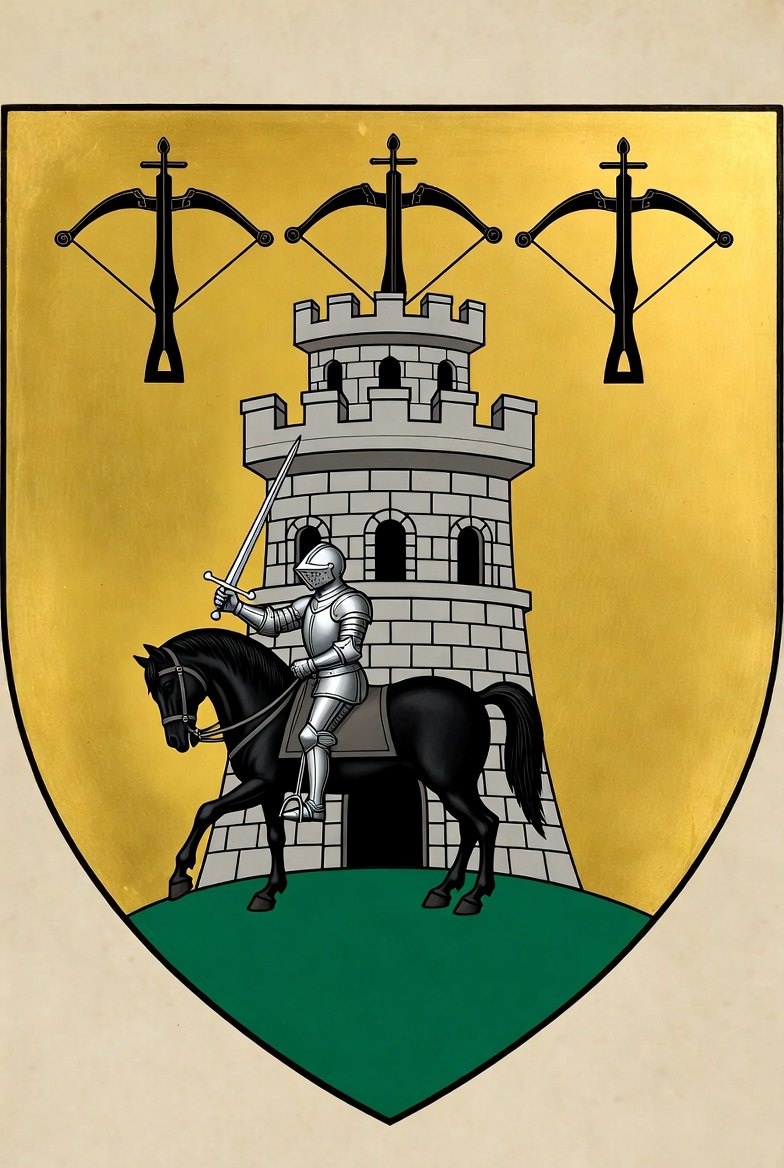
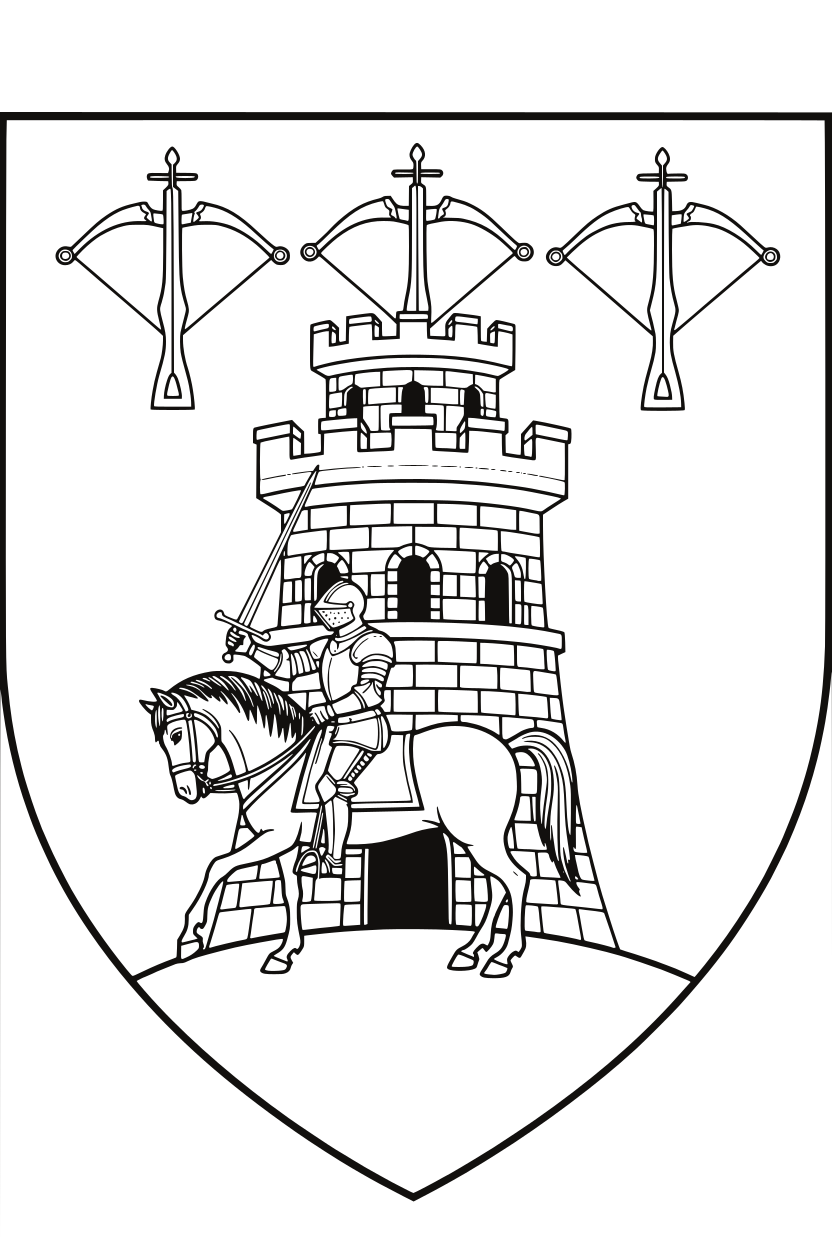
Almost everything circulating online as the «Almuiña coat of arms» is a generic illustration pulled from a template. Here is the same blazon —the very same, without changing a comma— worked out five times over, each as a different trade would have worked it: the illuminator of an armorial manuscript, the carver of a hidalgo's house, the engraver of a printed armorial, the stonemason of a façade, and the press of a sheet that has aged in an archive.
Crespo's same paragraph, resolved five times. None is more «true» than the others: a blazon is a text, and every trade and every medium has resolved it its own way. Pick below the one you want to see.
1 / 5
Flat tinctures, burnished gold and a black outline, like the plate of an illuminated book of arms.
Click the plate to see it full screen. The video has sound: you can turn it off with the speaker.
All five are recreations made for this page, not historical pieces: no armorial stone and no old engraving of this surname is known. What is historical is the text of the blazon, and it is the same in all five. The SVG of the first is a vector trace: it scales to any size without losing an edge.
The background. Or is the nobler of the two heraldic metals; the treatises associate it with nobility and generosity, though in practice it was often chosen because it contrasts with everything.
“Masoned” means the joints between the ashlars are marked; “outlined”, that it is edged in black. It is not the draughtsman's ornament: without them, the drawing does not meet the blazon.
The tower does not float: it rests on a green mound. It is the ground, actual soil. In a surname that means “orchard”, there is a certain charm in the only vegetal thing on the shield being precisely the ground.
A complete human figure, mounted and brandishing a sword. It is one of the rarest charges to be found on a Spanish shield: the usual fare is lions, castles, bends and scallop shells. An armed horseman is a blazon that wants to tell you something.
And the second rarity, in the highest and most visible part. The crossbow is a commoner's weapon and a weapon of precision, not a knight's: a crossbowman is cheap to train and it goes through armour. That three of them should appear, in chief, above the knight, says more about this coat of arms than everything else put together.
In the Spanish tradition arms belong to a specific lineage and a specific house, not to everyone who shares a surname. There is no “coat of arms of the Almuiña” in the sense of something that anyone called that is entitled to by right. Anyone who sells you the opposite, with your shield framed and a parchment, is selling you a decoration.
What does exist, and it is what you see here, is a blazon associated with the surname in the reference works: Fr. Crespo published it in 1997 in Blasones y Linajes de Galicia, and it appears likewise in the tradition of the Blasonario de la Consanguinidad Ibérica. That is a verifiable bibliographical fact, and it is presented as such.
Put another way: this coat of arms is cultural heritage belonging to the surname, and it deserves to be drawn properly. But it is not a title, and this page is not going to tell you that it is.
Chapter V · The numbers
There are no figures copied from another website here. The frequency file from the INE — 14.8 MB, 86,512 surnames, census as at 1 January 2025 — has been downloaded and counted. One thing worth knowing first: in Spain everyone carries two surnames, the first from the father and the second from the mother, and the statistics count each position separately.
Almost every page about this surname still gives rank 11,743 and 294 bearers. Those are figures from an earlier INE edition. With the census of 1 January 2025 the surname has dropped to rank 12,687 and has lost 12 first-surname bearers and 35 second-surname ones. It is no tragedy: it is what happens to a rural surname in an ageing district. But it is the figure, and it is stated here.
| Item | Figure in circulation | Census 1-I-2025 | Change |
|---|---|---|---|
| INE rank | 11,743 | 12,687 | −944 |
| First surname | 294 | 282 | −12 |
| Second surname | 303 | 268 | −35 |
Yes, but without the exaggeration everybody goes in for. The INE publishes 86,512 surnames — all those with 20 bearers or more. Almuiña is number 12,687. That leaves it in the most frequent 14.7%: there are 73,825 published surnames rarer than yours.
Put in terms of people: of every million Spaniards, six bear Almuiña as their first surname. And for every Almuiña there are 5,131 Garcías.
In the census there is a handful of surnames with exactly 282 first-surname bearers, the same as Almuiña. Among them, two that ring a bell:
IRIBARNE · MINGOTE · GUADALAJARA · IRAZOLA · CARABAÑO · XANDRI · PUERTES · DELFÍN · BUJEDO · RIOLOBOS · ABADAL · CUADRAT · SALARICH · PIEDROLA
There are as many Almuiña in Spain as there are Iribarne — Fraga's second surname — and as many as there are Mingote.
People with Almuiña as their first surname by province of birth (INE). By autonomous community: Galicia 250, Catalonia 6, Andalusia 5. Outside Galicia there is only the trace of internal migration.
Vigo has the largest number — 113 — but it is a city of 300,000 people: there the surname is diluted. Where it really weighs is in Taboada, at 11.31 per 1,000: one in every 88 inhabitants.
| Concello | Province | Bearers | Per 1,000 inhabitants |
|---|---|---|---|
| Vigo | Pontevedra | 113 | 0,38 |
| Taboada | Lugo | 30 | 11,31 |
| Ribadavia | Ourense | 28 | 5,62 |
| Chantada | Lugo | 22 | 2,75 |
| Lugo | Lugo | 19 | 0,19 |
| Antas de Ulla | Lugo | 16 | 8,48 |
| Pontevedra | Pontevedra | 14 | 0,17 |
| Baiona | Pontevedra | 13 | 1,04 |
| Santiago de Compostela | A Coruña | 13 | 0,13 |
| A Coruña | A Coruña | 12 | 0,05 |
| Ourense | Ourense | 12 | 0,12 |
| Monterroso | Lugo | 12 | 3,34 |
| Gondomar | Pontevedra | 9 | 0,60 |
| O Carballiño | Ourense | 9 | 0,64 |
| Arbo | Pontevedra | 8 | 2,99 |
| A Cañiza | Pontevedra | 8 | 1,57 |
| Ponteareas | Pontevedra | 8 | 0,35 |
| Ames | A Coruña | 7 | 0,22 |
| Cerdedo-Cotobade | Pontevedra | 7 | 1,23 |
| Crecente | Pontevedra | 6 | 2,98 |
IGE, municipal distribution of surnames as at 1 January 2023, first and second surname added together; only concellos with more than 5 bearers. Total in Galicia: 436, against the 481 counted by the ILG–USC census in 2001.
Chapter VI · The world
Between the middle of the nineteenth century and the middle of the twentieth, Galicia emptied out towards the Americas. The Almuiña boarded the same ships as everybody else. Today the surname is in seven countries and three continents.
World surname database apellidos.de (2026). By continent: Europe 271, South America 84, North and Central America 19. The world figures and the Spanish ones come from different sources and different years: that is why they do not tally when added up, and that is why they are given separately.
A word of warning about this map: these are the countries where the surname is documented in the databases consulted, not every country where there are Almuiña. A surname borne by five hundred people slips below the threshold of almost any statistic: there may well be Almuiña in Chile, in Mexico, in Uruguay, in Switzerland or in Australia without a single database recording it. What can be stated is the opposite: outside Galicia and the Galician emigration there is no origin of the surname anywhere at all. Every Almuiña in the world comes out of the same orchard.
Home. 72% of the world's Almuiña are still here, and almost all of them in Galicia.
The surname's second home, by a long way. The bulk of them live in the province of Buenos Aires, the offspring of the emigration of the late nineteenth and early twentieth centuries. The sculptor Susana Almuiña came from there.
The first great destination of the transoceanic Galician: the island of half of Galicia's grandmothers. The small Almuiña colony comes from those steamers between Vigo and Havana.
A classic destination for the twentieth-century Galician emigrant, tied to trade and to the isthmus.
In the middle of the twentieth century, Venezuela was Galicia's “eighth concello”. Post-war emigration took the surname to Caracas.
Minimal presence. There the ñ gets lost along the way and the surname almost always appears as Almuina.
A single registered bearer. The European frontier of the surname.
Until recently this page admitted to not having a single American document of the surname. Now it has one. In the Archivo General de Indias, among the files of embarkation licences for Cuba, there is one dated 22 April 1829: Antonio Francisco Almoyna, of San Xiao de Landrove (Viveiro), married to Teresa Cadórniga y Boado, applies for a licence for his son to sail to the island. What makes it watertight is that it can be proved to be the same family: three years later, in 1832, the Arquivo do Reino de Galicia calls him “Antonio Francisco Almuíña, marido de Teresa Cadórniga” (husband of Teresa Cadórniga). Two archives, two spellings, one single house. Complete passenger lists have still not turned up, and that does remain outstanding.
Chapter VII · The names
A surname borne by 545 people does not run to an encyclopaedia. It runs to this: a professor, an architect, a doctor who ended up as conselleiro, an economist who became a sculptor at fifty, a mayor, a civil servant in Isabelline Lugo, a carpenter prosecuted in 1936 and acquitted, and a Cuban literacy teacher dead at thirty-six. That is enough.
History
Garabelos (Mariz, Chantada), 1943
Historian, born in the heart of the Lugo concentration of the surname. Professor of Contemporary History at the Universidad de Valladolid, now emeritus, and a corresponding member of the Real Academia de la Historia for Simancas since 1998. His thesis, La prensa vallisoletana durante el siglo XIX (1808-1894), published in 1977 in two volumes and more than sixteen hundred pages, is still a reference work in the history of the Spanish press.
Architecture
Santiago de Compostela, 1946
Architect. He chaired the Santiago branch of the Colexio Oficial de Arquitectos de Galicia (1999–2007). With Rafael Baltar and José Antonio Bartolomé he signed the Santiago law courts building (1993–1995) and the extension of the Faculty of Political Science. He wrote Debuxo Técnico COU (1983).
Medicine and politics
Baiona, 1962
A medical graduate of the USC. Mayor of Baiona (2004–2015 and again since 2023), conselleiro de Sanidade in the Xunta (2015–2020) during the pandemic, chairman of the Vigo Port Authority (2020–2023) and a member of the Parliament of Galicia.
Art · diaspora
Buenos Aires → Virginia (EE. UU.)
Sculptor and painter. She took a degree in Economics in Buenos Aires and worked for thirty years at the International Monetary Fund before remaking herself as an artist: MFA from Virginia Commonwealth University (2009), adjunct professor there and exhibitions in Washington, Richmond and Baltimore. The Argentine branch of the surname, with a body of work.
Local politics
Baiona
A cousin of Jesús Vázquez Almuíña, he took over the mayoralty of Baiona between 2015 and 2023. Between the two of them, the surname was at the head of the concello for almost twenty years in a row.
Cuba · diaspora
La Habana, 1941 – Isla de Pinos, 1977
A literacy teacher during the Campaña de Alfabetización, Cuba's literacy campaign, and later a political cadre: a member of the National Bureau of the Unión de Jóvenes Comunistas from 1966 and first secretary of the party's regional committee on Isla de Pinos. He died at 36 in a road accident on his way back from a work assignment. His entry is in EcuRed; with a surname this rare, he is almost certainly descended from the Galician emigration to Cuba.
Administration
Lugo, 1848
On 8 October 1848 the Gaceta de Madrid published his appointments: “D. Antonio Almuiña, individuo de la comisión de examen de cuentas atrasadas de Lugo con 5000 rs., oficial tercero segundo del gobierno político de Lugo con 7000” (member of the commission examining Lugo's overdue accounts, at 5,000 reales, and second officer of the third class in the political government of Lugo, at 7,000). An Almuiña in the civil service of Isabelline Lugo, with his name, his post and his salary, in the official gazette of the state.
Civil war
Crecente → Gondomar, 1936
A carpenter, born in Crecente and living in Gondomar. At 21 he was tried in Vigo for “auxilio á rebelión” (aiding rebellion). The case ended in a provisional dismissal: he was not convicted. He is the only Almuiña in the victims database of the inter-university project Nomes e Voces.
And you?
The list is still open
If you have found a document, a photograph, a lead, new information or a mistake on this page: tell us. It all gets read.
WriteChapter VIII · The notebook
Search for “Almuíña” in the catalogue of the Arquivo do Reino de Galicia and limit the date to before 1603: nothing comes up. The surname did exist; it was written Almoiña. Changing the spelling pushes the trail back almost a century.
In the oldest document, the foro of 1505, the one who bears the surname is María de Almoiña. Her husband was surnamed something else — the parchment has faded and the catalogue reads “Estevo? de Parga?”. The surname enters history down the female line.
Four of the five places are A Almuíña. The one in Taboada is plain Almuíña. Losing the article is what happens to a common noun that has spent centuries being a proper name.
A Almuíña in Santo Acisclo do Valadouro, in Foz, did not appear in the 2003 Nomenclátor. It entered the 2026 one. There is a place called Almuíña that is officially younger than this century.
Of the six Romance forms of the Arabic munya, the Galician one has the most bearers in Spain: 282 against Almunia's 257. The most peripheral version turned out to be the most resilient.
In the 2025 census there are exactly 282 Almuiña as a first surname. The same as Iribarne, and the same as Mingote.
In Taboada (Lugo) there are 11.31 Almuiña per thousand inhabitants. It is the highest density in Galicia: in that concello, one in every 88 residents bears the surname.
Five people in Spain bear it twice over, from father and from mother. With 545 bearers spread across the whole country, that they should have met five times is no small thing.
This site lives at almuiña.com, but internally the internet calls it xn--almuia-0wa.com. That is Punycode: the system that allows an ñ into a domain name by translating it into characters that servers all over the world understand.
The crossbow is an extremely rare charge in Spanish heraldry, and a distinctly unchivalrous one: it was the weapon that let a commoner bring down a nobleman at two hundred paces. On this shield there are three, and they are above the knight.
Between the previous INE edition and the 2025 census, the surname lost 12 first-surname bearers and 35 second-surname ones, and dropped 944 places in the ranking. Rural surnames grow old along with their districts.
Chapter IX · The sources
Everything above comes from somewhere. These are the sources, and after them, the sums that do not add up and why.
Chapter X · You
If you have found a document, a photograph, a lead, new information or a mistake on this page: tell us. It all gets read.
Behind this page
Carlos José Almuiña Jiménez
If you would rather write directly, without the form: contact@norbilandia.com